
The Global Basketball Map
Understanding the global landscape and how it relates to NBA scouting.

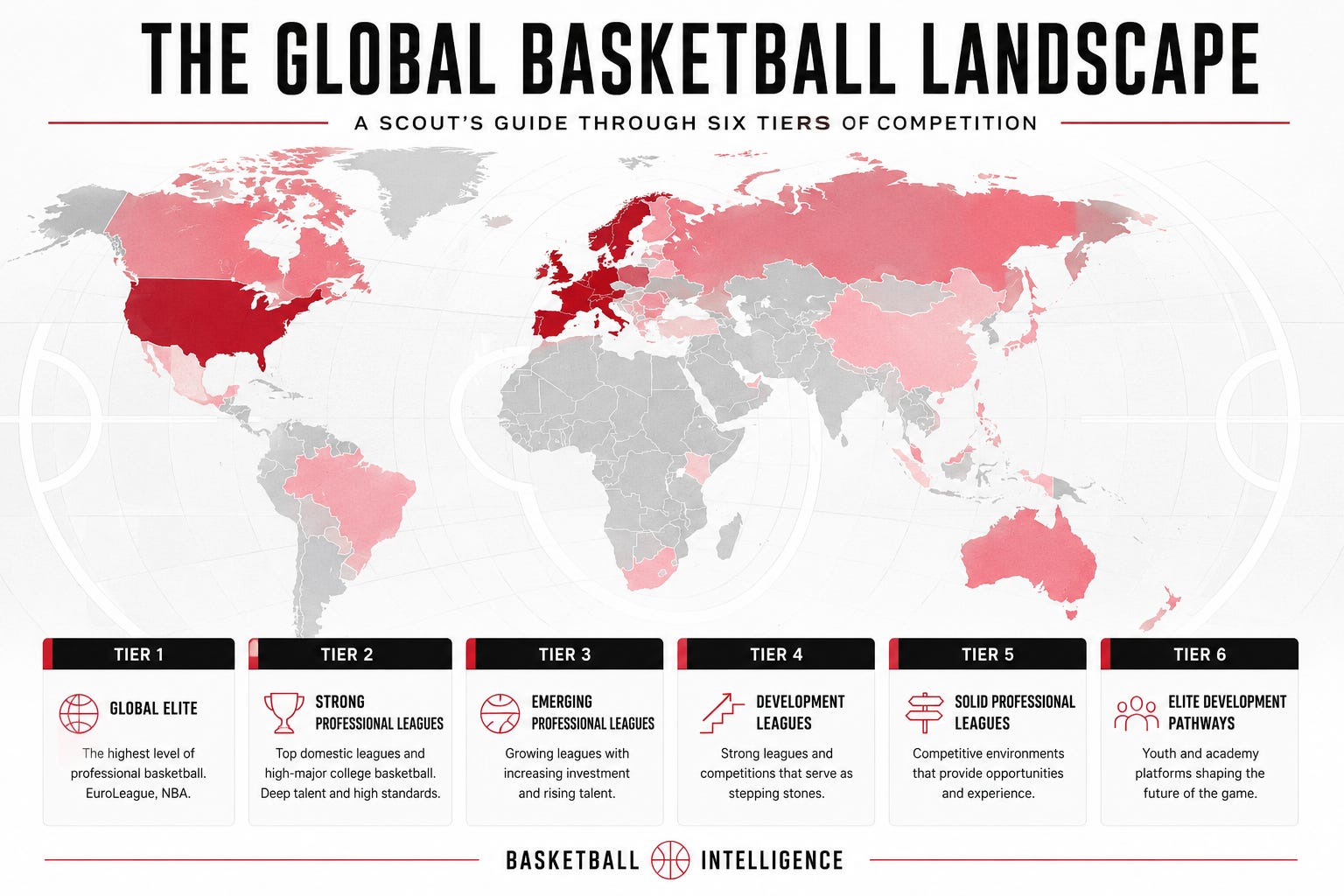
One of the most common questions I get asked is how the global basketball landscape actually works — which leagues stack up, which are best for prospects, etc. As the game has grown globally, understanding the importance of each region, fostering real relationships and becoming an expert has become more and more valuable. The reality is there are very few American scouts working full-time internationally (I can probably count on one hand in regards to the number of American scouts across the league who were working in this space over the past couple of years). The overwhelming majority of international scouts are from Europe, with some consultants sprinkled around the globe specializing in their home markets. In a business based on relationships and information, it’s hard to make a case for anyone better suited than the people from the desired region you are scouting.
So how does one get acquainted with so many different leagues around the world? Learning the global game is a lot like learning a new language—the fastest way is complete immersion, throwing yourself into an environment that forces you to adapt. With enough time, familiarity begins to replace confusion. I was fortunate enough to have played for a decade around the globe, covering both the European and Australian markets, never more than a degree of separation away from the top level. That exposure, experiences and built relationships has proved to be incredibly valuable in my own journey.
While every league deserves its own thousands of words, I will lay out everything you need to know about leagues and events around the world in hopes of giving you a foundational guide to how basketball is viewed around the world from the eyes of the NBA and beyond.
Ultimately, every league tells a different story. Variations in play styles, competitiveness, coaching philosophies and expectations are threads that must be unraveled to accurately assess a prospect. My goal in this article is to provide a framework that helps you understand those differences really mean because the most important question in global scouting isn’t necessarily about where a player is competing, but rather what success in that environment actually tells us about who they can become.
THE GLOBAL FRAMEWORK
I think one of the most important things to do as a scout is to find “your way” of doing things. Building processes and implementing systems allows you to remain organized in a sea of information to track, hone in on players flying under the radar and ultimately correct and improve on your own personal biases to become the best evaluator possible. Throughout my time in the NBA, the following framework became the most effective way for me to evaluate athletes.
1. Competition Level
This is without a doubt, one of the most important aspects when watching a player. It can be tough to evaluate a player without having any real context. A guard with great burst on film that doesn’t play against great length or size can be deceiving, just like a great athlete that is surrounded by lower IQ players can appear to be more translatable than he really is.
When watching prospects, the question isn’t necessarily, “is this a good league” as much as it is, “how difficult is it to consistently produce in this particular ecosystem?” I’ve come to quickly find this to be a much more valuable approach than to simply identify the quality of play from a prospect. The more accurately I understood the players surrounding a prospect, the easier it became to judge whether his advantages were legitimately translatable. A brief list of things to consider include:
Overall Talent of the Game
Shotmaking, skill level, physicality, athleticism, IQ.
Veteran Experience
The quality of the veteran dictates how much thinking a prospect needs to be able to do on the floor.
Coaching Quality
An underrated aspect — are the schemes too simplistic, are the hurdles too easy to overcome?
Depth Of Competition
Are teams 6-7 deep (signs of lower level leagues) or are the 8-10 rotational players providing outcomes?
Internationally, a young player that produces against a Spanish ACB or Australian NBL club would be playing against better competition in rotation player 7-10 than say Sweden or Japan. This context becomes important when evaluating how a prospect impacts the game.
2. DEVELOPMENT ENVIRONMENT
I cannot overstate how important this is for an evaluator to understand—being able to get on the floor in the EuroLeague or other high level leagues moves a draft prospect up a tier or two. I was a firm believer that if Sergio De Larrea was in college, he would have consistently been talked about as a top 20 prospect or better. Similarly, Alexandros Samodurov who has played most recently at Panathinaikos in Greece, has struggled to see consistent floor time amid a roster full of former NBA players.
It’s well known in the scouting community high level European clubs are reluctant to play their younger prospects for a multitude of reasons which include the physical immaturity, fear of having their top young prospects poached by the NBA, NCAA or other clubs and the ultimate “win-now” precedent where no job is ever safe.
Typically, there are three types of environments in professional basketball—the win now environment (as noted above), the developmental environments (MEGA in Serbia is an excellent example of this) and hybrid environments where prospects have the ability to thrive in their opportunity while surrounded by other high level talents.
This is why context is important for younger prospects playing in EuroCup, Germany or even some of the French teams. They are often good enough to be part of a strong club but opt for the playing opportunities elsewhere to aide in their development.
3. STYLE OF PLAY
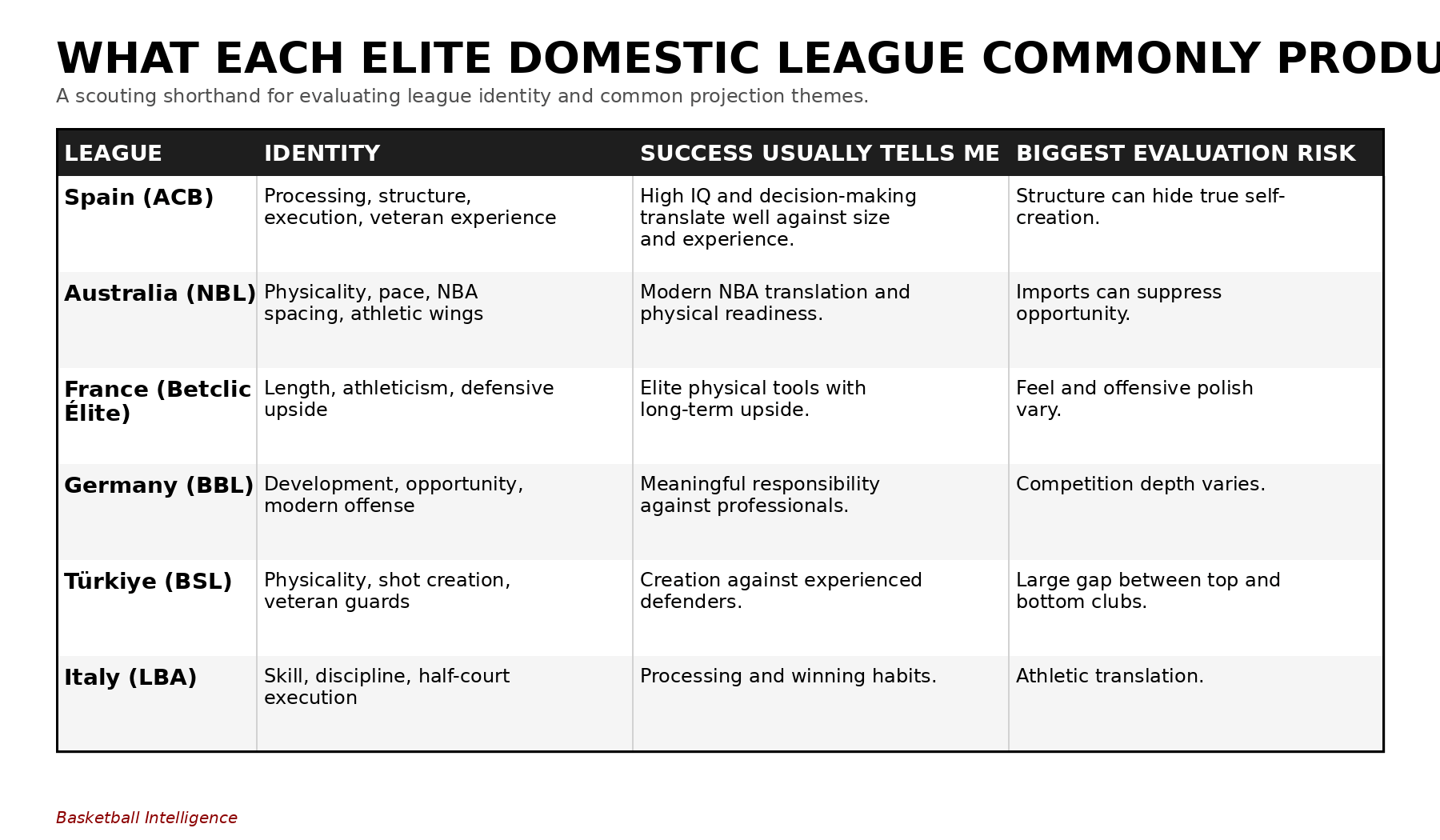
The best question to ask, “what basketball skill does this league consistently reward?” Having been an import who played in several countries, I quickly learned each league is officiated differently. Here in Australia, they promote physicality but officials are much quicker on the whistle than most European countries. The same applies for style and skillset, for example the ACB rewards high processing levels while France is filled with length and athletes. Below is a quick list for references:
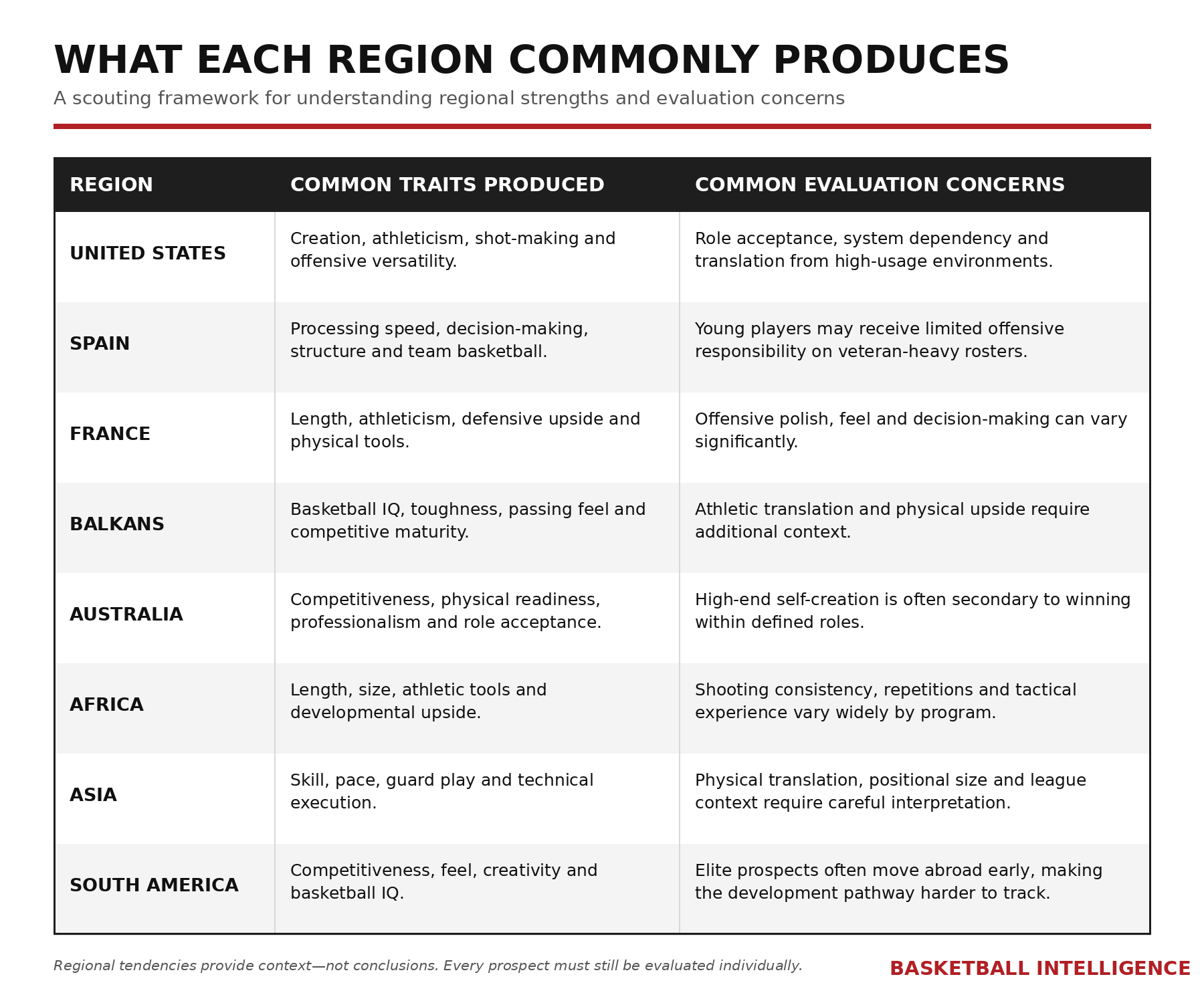
While this is merely a snapshot of some of the major markets, understanding themes is essential to correctly evaluating a prospect.
4. TRANSLATABILITY
The first three steps create context. This is where the work front office executives become more interested: projection. A handful of questions to answer:
Are they NBA ready once drafted?
What parts of this players game are going to directly translate to an NBA floor?
What parts of their game can be developed to become an asset?
What part of their game is going to cause them to fail or limit their ceiling? How realistically can this limitation be corrected?
This is where the value of the first three steps and the importance of genuine relationships come into play so your intel on a player is accurate with good depth. Some leagues are much easier to watch and project a player. The NCAA and Australian NBL are the two easiest in my opinion as both have pace, quality talent and similar principles. As the NCAA continues to evolve in terms of play style, the quality of the Power 4 conferences (ACC, Big 10, Big 12 and SEC) are filled with NBA talent on a nightly basis with the top prospects in the world playing there. The NBL provides a lot of floor spacing and three point shooting where import guards thrive more than bigs in how they influence the game, much like today’s NBA ecosystem.
5. EVALUATION RISK
The most important thing to ask yourself is often not why a player will pan out but rather why they won’t pan out. A great starting point is by looking at the level first. Each league hides something in a prospect.
Heavy structure, as seen in many of the European leagues, can sometimes make it difficult to separate genuine processing ability from familiarity with a well-rehearsed system. A player may consistently make the correct read within a defined structure, but as an evaluator, we must study how he processes broken possessions, shifting coverages and situations where the game is less predictable to identify how translatable his skillset is to an NBA floor.
Furthermore, the context of the league is important to understand as it can help flag inflated statistics in the box score. In certain leagues pace, defensive principles, roster construction or inconsistent resistance can create cleaner scoring opportunities and inflate particular statistics like offensive rebounding due to more available possessions. That’s why every box score comes with a grain of salt. It becomes about the translatability of a prospect, not the sheer box score output.
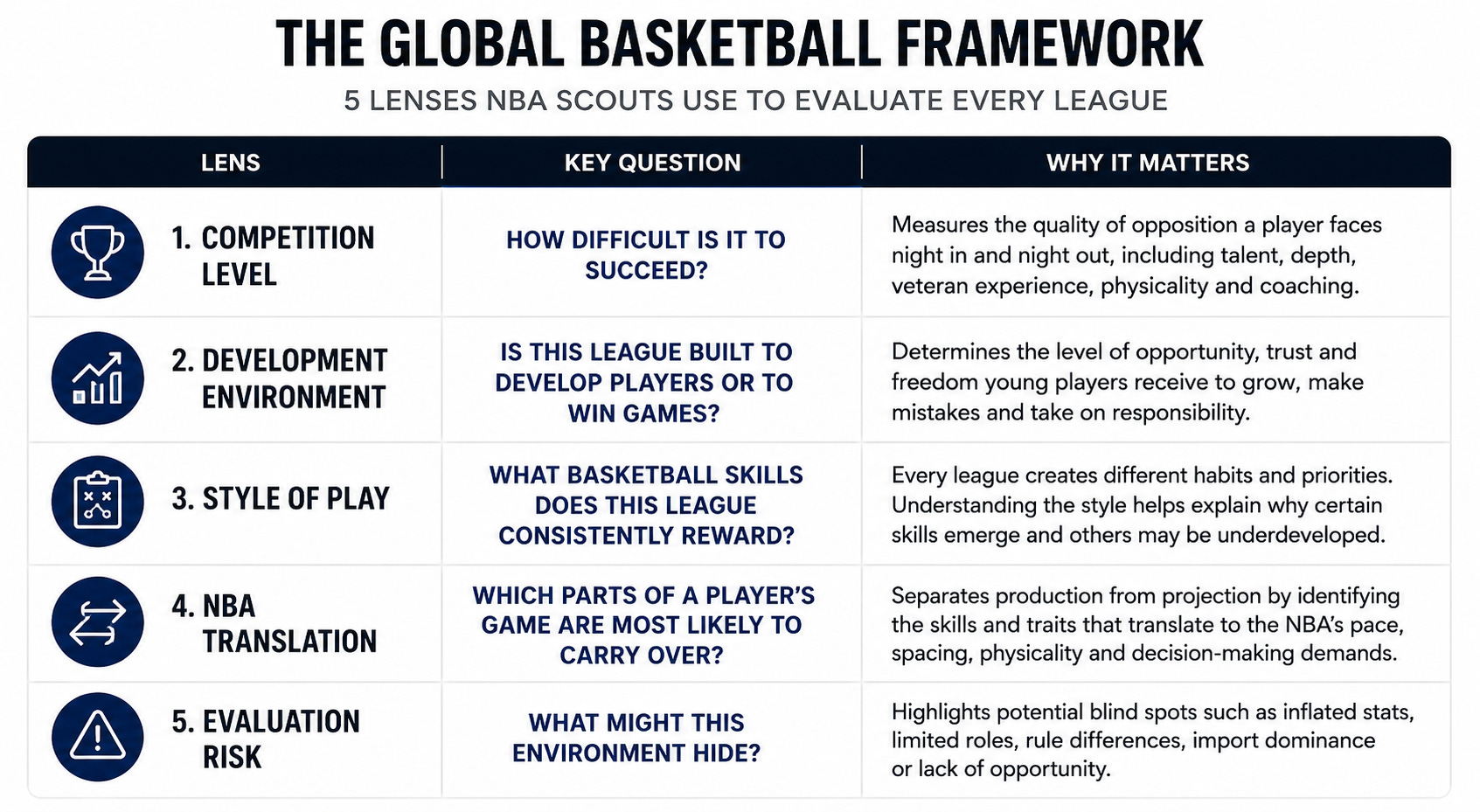
A framework allows for consistency, efficiency and improvement. No single category can tell an entire story and there’s certainly no one-size-fits-all approach to scouting but you can create early context that helps gain familiarity in a league. Below is a summary of the above:
THE GLOBAL PYRAMID
One of the biggest misconceptions about international basketball is that leagues exist in isolation. In reality, they form a connected ecosystem. Players are constantly moving between domestic leagues, international competitions and development pathways, each representing a different level of competition and opportunity.
Understanding where a league sits within that ecosystem provides immediate context when evaluating a prospect. It helps answer questions like:
How difficult is this environment?
Who is this player competing against?
Where do players typically move next?
How much weight should production carry relative to other leagues?
Although every player’s journey is unique, most pathways generally follow the same competitive hierarchy.
Assuming we can all agree that the top league in the world is the NBA, below is a graphic of the tiers of leagues around the world:
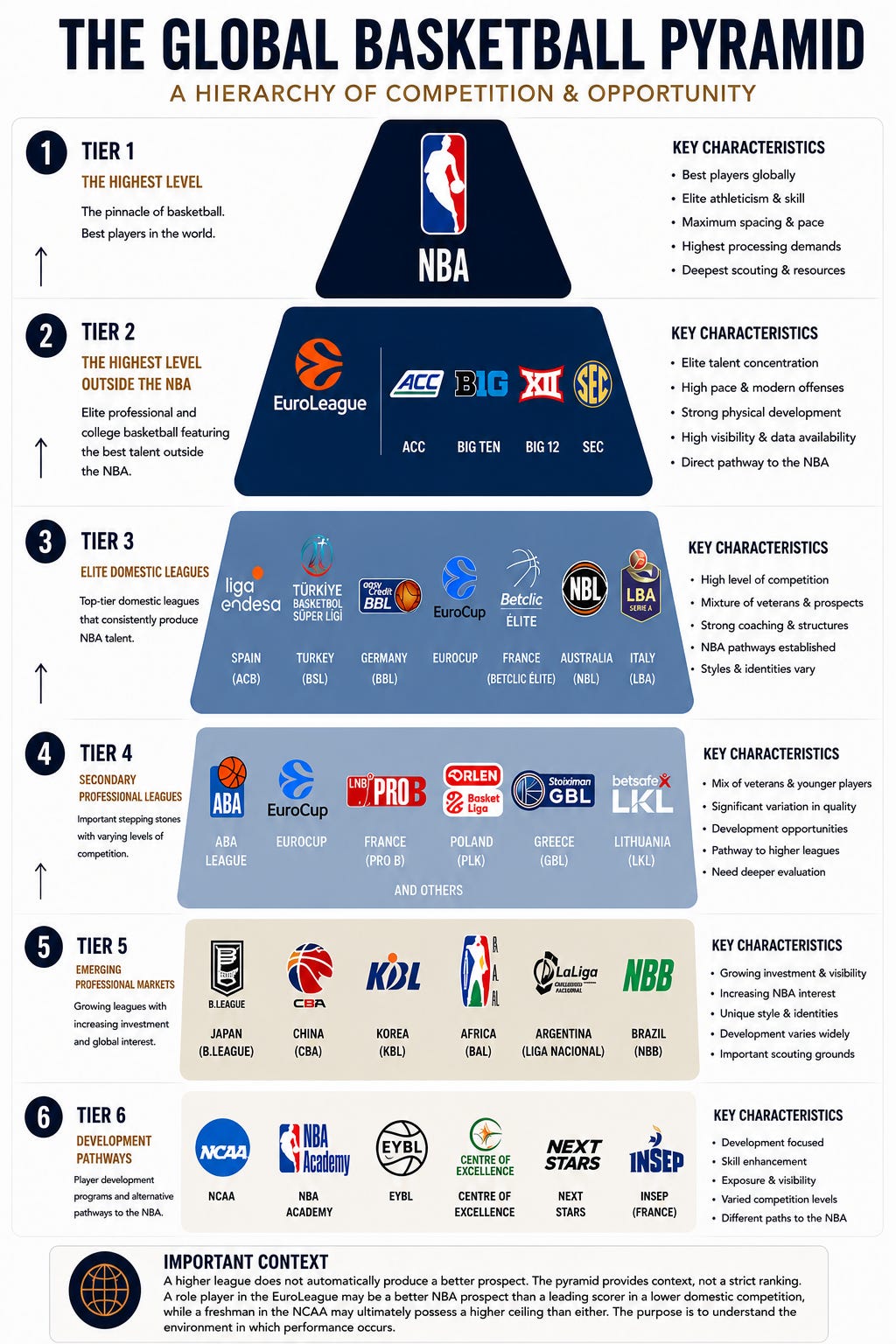
It's important to note that these tiers are not fixed. League strength fluctuates from season to season and every scout will view the global landscape slightly differently. This hierarchy reflects my own evaluation of overall league strength rather than the likelihood of finding NBA prospects. For example, while the Greek Basket League features two of the best clubs in the world in Panathinaikos and Olympiacos, the depth of the league as a whole places it lower in my overall hierarchy.
TIER 2
The highest level outside of the NBA and often full of NBA-caliber prospects, free agents and veterans. Budgets are in the multimillion’s (as much as 40 million per club per some speculation in the EuroLeague) and talent is abundant.
EUROLEAGUE
One of the greatest misconceptions by the average basketball fan is the talent outside of the NBA means they aren’t NBA caliber players. The reality is the EuroLeague is made dozens of NBA quality players. Some, particularly European’s, choose to play in the EuroLeague over NBA teams, opting for bigger roles, sometimes more money and to be in a more familiar setting. You also see NBA veterans struggle to play in the EuroLeague after successful NBA careers, unable to conform to the style and detailed demands in the competition. This is why young prospects who can get on the floor and produce become extremely attractive to NBA personnel. Sergio De Larrea and Hugo Gonzalez are two examples of players with limited opportunity who were drafted in the first round because of the respect NBA GM’s have for the level of the league. In my view, if both spent their final year in the NCAA rather than the EuroLeague, they would have both been top 15 picks.
Success in the EuroLeague for young prospects hints at a few key traits translating well in the NBA:
Processing — players are forced to read multiple coverages, execute with precision and make quick decisions against experience and length.
Role Acceptance — one of the big draws to both Gonzalez and De Larrea was the intel on them and their willingness to play a smaller part early on in their careers as they will fight to develop. This is invaluable and points to their headspace’s.
Maturity — they understand what it truly takes to be a professional at a young age—two practices per day, hard coaching and a growth mindset.
Defensive Accountability — many young players struggle with defensive buy in and consistent performance. To get on the floor in the EuroLeague a level of effort and execution must be had. What they may lack physically, they make up for in effort and attention to detail.
In an environment where winning is everything, invaluable lessons are learned at an early age. Playing in the EuroLeague doesn’t necessarily tell you how high a players ceiling is, but rather does reveal how consistently they think, execute and play with effort against some of the best professionals in the world.
The EuroLeague doesn’t always reveal how high a prospect’s ceiling is, it reveals how much of his game already translates to winning basketball.
Furthermore, the EuroLeague is a great place for teams to find cheaper free agents to fill out rotational roles. This off season alone, Alpha Diallo and Tarik Biberovic (both players I've been high on) have signed NBA deals. Their experience, skillset and work rate should allow for both of them to be successful in their roles at the next level and contribute to winning.
NCAA POWER 4
Known as the Power 4, the ACC, B10, Big 12 and SEC make up the “high major” portion of college basketball. While we won’t get too deep into this as it is well understood around the world, the money now available with NIL has pulled the overwhelming majority of top prospects around the world out of their domestic leagues and into the NCAA. With nightly challenges of future NBA players all over the floor, there’s plenty of eyes on college basketball by NBA front offices and where many of the resources are spent. The addition of NIL has been great for evaluators, getting to see the international prospects play against the top US competition and easier to compare prospects.
TIER 3
While Tier 2 naturally attracts much of the attention from NBA front offices, I’ve found Tier 3 to be where some of the best long-term value can be uncovered. Every front office is searching for the same thing—a player who can outperform their draft position or contract. These leagues consistently produce prospects who may not generate the same fanfare as EuroLeague players but possess many of the tools necessary to become valuable NBA contributors.
I’ve spoken a lot about De Larrea to this point but his inability to find consistent minutes in the EuroLeague wasn’t ideal but he was given opportunity in the Spanish ACB, which is where I really grew to love him as a player. The same goes for Jack Kayil who played at Alba Berlin in the German BBL and Karim Lopez coming from the Australian NBL, being examples from this draft alone of benefiting from playing larger roles in highly competitive leagues.
SPAIN — LIGA EDENSA (ACB)
In fairness, I had a hard time putting the ACB in Tier 3 but it isn’t quite the same as the EuroLeague. Still, it’s widely regarded as the second best league in the world and the top domestic competition out there. The ACB’s blend of tactic, veteran experience, athleticism, physicality and pace (the ACB runs on a “quick inbound” or “no-touch” where it allows teams to inbound the ball on a turnover in the backcourt without waiting for the referee to check the ball — much like soccer which makes the games extremely high pace and fun to watch) allow it to consistently produce enticing NBA prospects who seem to transition well to the style and level of the NBA.
Typically prospects playing in the Spanish ACB are high IQ guards or skilled wings, like Gonzalez and De Larrea most recently, or going back to Luka Doncic. Bigs are often skilled and floor spacers with the ability to pass the ball. To play in the ACB, thinking and having the skill to execute are what make players successful, while players who rely on athleticism alone typically don’t fair as well.
Being able to thrive in the ACB tells me prospects are thinkers, skilled and can handle the size, length and skill of the NBA. The one concern I'd have typically comes from how structured a team is — does the player have the ability to consistently make things happen in the broken play or are they relying on the structure and execution to create advantages and make reads?
AUSTRALIA — NBL
In a remote corner of the world, the NBL has done an excellent job in developing and promoting itself as an NBA stepping stone destination. It has a proven track record of varying prospects being drafted, in thanks to the Next Stars Program which we will breakdown later, and free agent signings. The league boasts pace and breaks the rigid mold of the European styles while still forcing players to process, making NBA reads and fit into looser structure. This style of play makes it easier to predict translatability of a prospect.
The NBL is one of the most competitive leagues in the world, with any team legitimately able to beat any other team on any given night. This is largely due to the similar budgets of each team and stricter salary cap’s than many other leagues have. That forces players to compete night in and night out to succeed and earn the next deal.
Players who thrive in this league can do so in a variety of ways. Physicality and toughness is a non-negotiable, while being able to read the game and having an elite skill. As of late, modern wings and versatile forwards have been the calling card for NBA interest, ranging from Josh Giddey and LaMelo Ball (both are PG’s but boast size and versatility), to Rayan Rupert, Ousmane Dieng, Jaylin Galloway, to more modern forwards like Jock Landale, Xavier Cooks, Mitch Creek and Lachlan Olbrich amongst many others that have made the jump to the NBA in some capacity.
The biggest challenge in evaluating an NBL prospect is understanding the role they can play. Import guards and marquee signings tend to dominate the ball and if a prospect lands in a non-star-centric scheme, determining whether or not they can consistently produce can be challenging. The other aspect is while physicality is important, the NBL lacks true NBA size, unlike the EuroLeague. Teams tend to effectively run smaller, mobile 4’s (6’6-6’8) and the 7’0+ bigs tend to struggle with the pace of play. Determining whether the prospect will handle high end physical tools at the next level is something to consider.
The NBL also serves as a great spot for free agent signings, particularly two-way candidates. The league typically ends in early March for most players which is enticing to both European and NBA organizations to bring in high level players for the backend of a season.
The NBL serves as the closes international league to the modern NBA in both style and need which has made it such a promising scouting market for many teams.
FRANCE — BETCLIC ELITE
France has arguably become the world’s premier producer of NBA physical talent. During my short stint as a player in France, this was true of every league in the country and has only continued to evolve since then. Year after year, long, athletic wings and mobile bigs emerge from the French system, giving NBA teams one of the deepest talent pools outside the United States. The addition of Nathan Soliman this year and Hugo Yimga-Moukouri are just two of the many exciting prospects to watch this year.
French basketball places a premium on length, athleticism and defensive versatility. The country’s development pathway encourages players to defend multiple positions while gradually expanding their offensive responsibilities. Because of this, many prospects enter the NBA with elite physical tools before their offensive games are fully developed but their defensive potential is excellent in the eyes of NBA decision makers.
Success in France generally tells me a player possesses legitimate NBA physical traits and defensive upside. When those physical tools are paired with high-level processing and decision-making, the ceiling becomes extremely intriguing.
The evaluation challenge is separating physical potential from basketball polish. It can be easy to fall in love with the idea of what a prospect can become, but it’s important to consider the likelihood of that player reaching that ceiling. Athleticism alone can dominate junior levels, but as players progress, feel for the game, shooting and decision-making become increasingly important. While the French League provides plenty of veteran experience and some excellent clubs with rich history’s, I find it more important to evaluate the prospect in the role they will fill at the next level more than simple production in the French league. Nonetheless, there are excellent prospects coming through France right now that we should all be excited about.
GERMANY — BUNDESLIGA (BBL)
Germany has quietly established itself as one of Europe’s strongest development environments. Clubs such as Ulm, ALBA Berlin, Bayern Munich and Wuerzburg have demonstrated a willingness to trust younger players with meaningful roles while maintaining strong professional standards, making this an underrated market for prospects in my opinion. Having recently seen Hannes Steinbach and Jack Kayil recently playing in the BBL over the last couple of years to being drafted are highlights to what Germany has to offer.
The BBL blends modern offensive principles with quality coaching and increasingly athletic competition. Compared to some of Europe’s more veteran-heavy leagues, Germany often provides greater developmental opportunity without sacrificing competition. Some may see the BBL as a stepping stone league to the pinnacle of European basketball but that hunger in players to compete each night is what makes it valuable.
Prospects who succeed in Germany typically demonstrate strong offensive feel, positional versatility and an ability to contribute within winning basketball. The willingness of clubs to invest in younger players makes projection considerably easier than environments where opportunities are scarce.
Competition depth can vary from club to club, making context particularly important when evaluating production. Not every game presents the same level of challenge, requiring evaluators to carefully consider opponent quality. It’s important to prioritize games against the top teams like Alba or Bayern rather than some of the bottom teams. The biggest knock on Germany as a scouting market is the lack of depth in the league — still high level players and teams but not quite the same as the ACB or when considering NBA standards.
TURKIYE — BASKETBOL SUPER LIGI (BSL)
The Turkish BSL combines elite clubs with outstanding individual talent (such as Fenerbahce, Besiktas, Bahhcesehir and Anadolu Efes) and remains one of Europe’s strongest domestic competitions. The physicality of the league, combined with high-level guard play and experienced veterans, creates a demanding environment for young prospects.
The league has traditionally rewarded skilled shot creators, physical wings and versatile forwards capable of impacting both ends of the floor. The quality of coaching and investment from top organizations continues to make Türkiye an attractive destination for both established professionals and developing prospects.
Success in the BSL demonstrates a player’s ability to compete physically while maintaining offensive efficiency against experienced defenders. Guards who consistently create advantages here generally possess NBA-calibre offensive tools.
The largest evaluation challenge is the gap between the league’s elite organizations and its lower-ranked clubs. Production must always be viewed within the context of competition level and role, prioritizing the top league games rather than the bottom.
ITALY — LEGA BASKET SERIE A (LBA)
Italian basketball has a rich tradition that has long been built upon structure, execution and skill. While the league may not consistently produce the same volume of NBA prospects as Spain or France, it remains an excellent environment for developing fundamentally sound players who understand how to play within a team. Most recently was Quinn Ellis for Milan who had a strong season in both Italy and the EuroLeague which started to gain traction around the league before signing to play in college and take advantage of the NIL deal with St. Johns.
The LBA emphasizes spacing, passing and half-court execution. Players who thrive in Italy typically possess strong feel for the game, offensive discipline and the ability to contribute without dominating possessions.
Success in Italy often reflects processing, adaptability and offensive maturity. Players who consistently make winning decisions tend to separate themselves quickly.
The evaluation challenge lies in projecting athletic translation. Because the overall league is generally less explosive than some of its European rivals. Evaluators must determine whether advantages created through skill and timing will continue against NBA athleticism.
TIER 4
Not every great prospect develops in the world’s strongest leagues. Some environments simply provide a better opportunity to play, make mistakes and expand a player’s game.
Tier 4 leagues occupy an important and underrated place in the global basketball ecosystem. They are often populated by younger professionals, developing veterans and players searching for their next opportunity. While the overall level of competition is generally below the elite domestic leagues, these competitions regularly produce future EuroLeague players and, on occasion, NBA talent.
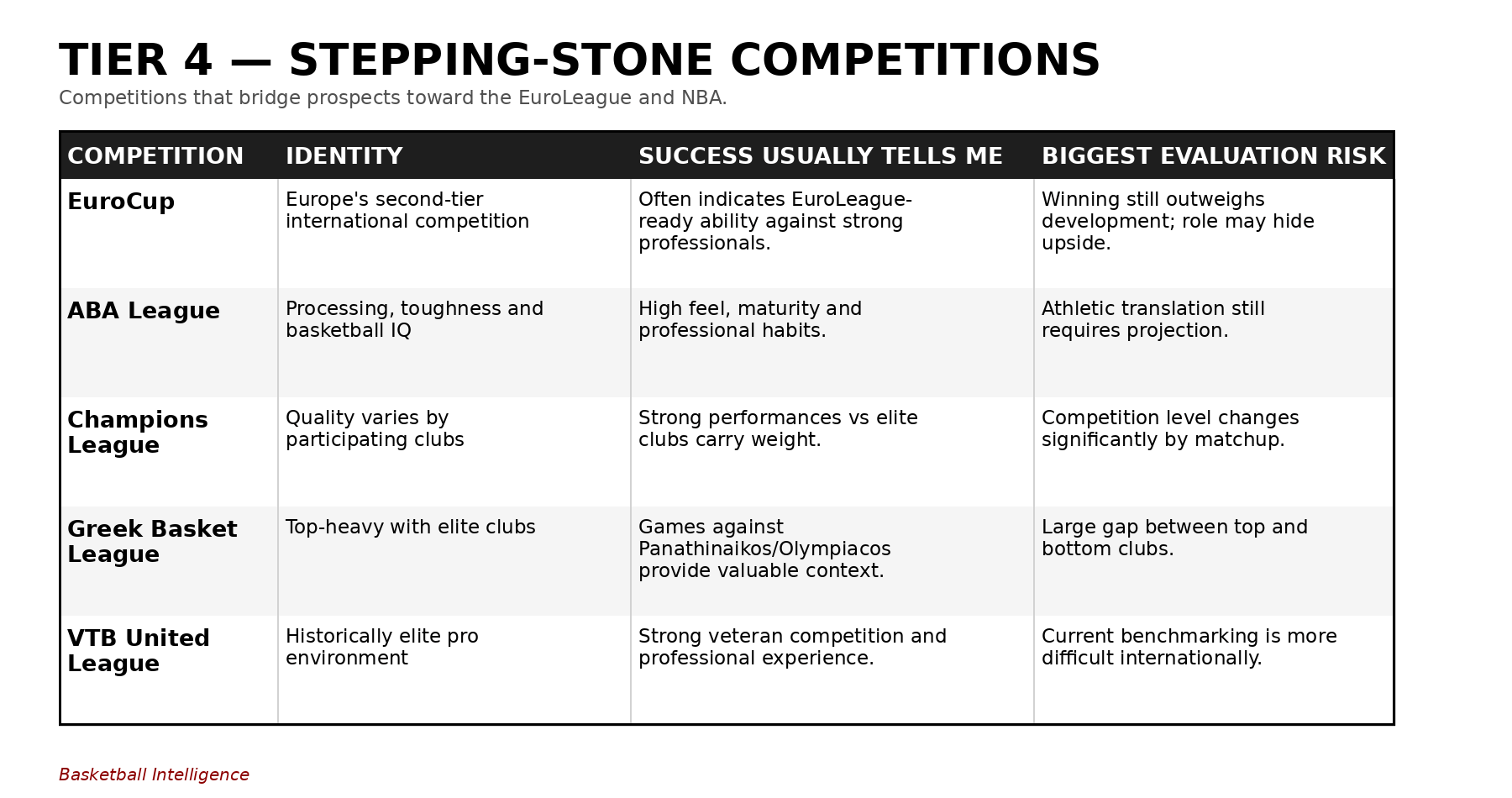
In a tier full of international and domestic competitions, understanding the context of the following leagues helps create a clearer image of the prospect.
EUROCUP
The EuroCup is unique because it isn’t a domestic league but rather Europe’s second-tier international club competition. While it sits below the EuroLeague, many of its clubs are capable of competing with high-level domestic champions, making it one of the strongest environments outside Europe’s premier competition and an argument could be made this should have been a Tier 3 competition.
Many organizations use the EuroCup as a stepping stone to the EuroLeague, and success here often leads to opportunities at the highest level. Because clubs remain highly competitive, younger prospects still face many of the same challenges found in the EuroLeague, albeit with slightly greater opportunity.
Typical prospects in this league are advancing EuroLeague caliber players, still filled with plenty of veteran presence and young pro’s. Again, because it’s viewed as a stepping stone league to the truly elite, I knocked it down a peg but not to say there isn’t a ton of potential here.
Successful players are capable of producing against strong professional competition at one of the highest levels in the world. Most recently, Joan Beringer who played for Cedevita Olimpija Ljubljana in Slovenia was drafted by the Timberwolves in the first round of the 2025 draft. A young player with a ton of upside who still needs time to develop but the foundation is there. His ability to get on the floor at that point in his development is a great example of what the EuroCup can be used for and is a great league to track long term prospects.
ADRIATIC LEAGUE (ABA)
Consisting of primarily Eastern European countries (Serbia, Slovenia, Croatia, Montenegro) this is a league full of high IQ, extremely tough and extremely disciplined players. With a wide range of clubs from EuroLeague teams like Dubai, Partizan and Red Star to a host of Eurocup teams to prominent domestic ones, the ABA can host a wealth of intrigue.
Outside of the top clubs mentioned above, MEGA in Serbia tends to be one of the most important clubs to track in the international space. MEGA provides opportunity for the top young prospects in the region and beyond, giving them opportunity, high level coaching and the chance to compete in one of the top regions in the world. Most recently Bogoljub Markovic was drafted in 2025 by Milwaukee and I’m on board the hype train with him — I believe he has all the makings of being a versatile four in today’s game.
The two concerns I tend to have with the Adriatic are the depth of the league and the translation of play style. This region isn’t known for its high end athletes (Doncic, Jokic, etc.) but rather the skill, toughness and feel the players possess. Projecting whether their game will translate against high end athletes becomes the question.
GREECE — GREEK BASKET LEAGUE (GBL)
The GBL presents one of the more difficult evaluation environments because the gap between the top and bottom clubs is so significant. Panathinaikos and Olympiacos elevate the overall reputation of the league, yet much of the domestic competition falls well below EuroLeague standard. Greece was once one of the prominent markets but financial instability over more than two decades has hurt the stability and competitiveness of the league.
For prospects outside those organizations, opportunities can be excellent, but production must always be viewed through the lens of competition quality and prioritized against the top clubs. Even then, it may not paint an accurate picture.
VTB United League
Despite geopolitical changes reducing its relevance for NBA scouting, the VTB historically provided one of Europe’s strongest professional environments. CSKA Moscow, Zenit and UNICS Kazan consistently competed at EuroLeague level before Russian clubs were suspended from European competition.
Today, the league still contains quality professionals but has become more isolated from the broader European ecosystem.
Basketball Champions League (BCL)
The Basketball Champions League occupies an interesting position because the quality varies substantially depending on the participating clubs each season.
Strong clubs can resemble EuroCup competition, while weaker participants more closely mirror domestic Tier 4 environments.
This is still a strong league to identify younger prospects in to follow over the coming years. Tracking how a prospect develops can often paint a more clear picture during the necessary evaluations down the line.
Lithuania — LKL
Lithuania continues to produce some of the world’s smartest basketball players. The league emphasizes shooting, passing and decision-making, while the country’s basketball culture ensures young players develop strong foundations. Clubs like Zalgiris are known to do a good job in developing their youth players to be successful pro’s at every level.
TIER 5
Tier 5 represents solid professional leagues, many of which are demonstrating growth in the right directions but for now, have their significant shortcomings that make it hard to justify pouring heavy resources into these markets. They are often stepping stone leagues or serve as payday’s for high level imports on the wrong side of their prime or who prioritize the paycheck over competition (nothing wrong with that!) particularly in the Asian markets.
Each year, players still pop up from the regions. Often times these players are great G League options for teams. As a scout, the focus isn’t always solely on the NBA side, you have to also think of the development and G League pathways. In 2025, we were able to secure the G League rights to Aliou Diarra who I saw live in South Africa at the BAL Playoffs. Diarra eventually signed a lucrative deal to play in Italy and the EuroLeague last year but has NBA potential as a high energy rebounder and defender that impacts winning in a very real way. He just needs time to develop.
I tell that story to highlight the value of these leagues — full of talent that needs further development and opportunity. With the right plan and better resources, a lot of development pieces can be found in these leagues.
TIER 6
While the bottom of the pyramid, it’s actually one of, if not the most important, part of the pyramid when it comes to scouting and understanding the global landscape. As noted throughout the article, a ton of young prospects struggle to get on the floor in meaningful minutes in the top leagues, but these opportunities in Tier 6 put them on the floor with players in their own age group where their talent really shines while simultaneously giving them game reps.
While winning is important to some programs, others completely prioritize the development of the players they view as having long term potential, regardless of wins and losses.
USA — EYBL AND SIMILAR AAU CIRCUITS
The EYBL and other competitors has become the premier grassroots pathway in the United States and consistently produces the largest concentration of future NBA talent in any single youth competition. The sheer depth of talent is remarkable, with virtually every major NBA front office represented throughout the circuit.
What makes these events unique is the amount of individual talent on the floor. Prospects are forced to create advantages against elite athletes every possession, making it an outstanding environment for evaluating athleticism, shot creation and competitiveness.
The challenge, however, is context. AAU basketball naturally emphasizes individual creation more than structure. Team continuity is limited, coaching philosophies vary and defensive execution often takes a back seat to offensive freedom. As a result, evaluators must be careful not to overvalue difficult shot making or raw production without considering decision-making and role translation. I think it’s best used as a raw talent identifier and allowing the college journey to better indicate translatability and impact on winning.
ADIDAS NEXT GENERATION TOURNAMENT (ANGT)
The ANGT is arguably Europe’s premier junior event and provides one of the clearest snapshots of the continent’s top prospects. Made up of 4 events and 32 teams, this is the most important non-national set of events for international juniors, in my opinion.Unlike the EYBL, players generally arrive representing professional clubs rather than independent programs, resulting in significantly more structure and continuity (the NXT GEN team in each event made up of various prospects being the exception).
Since many participants already train within professional organizations, processing speed, team concepts and decision-making are often more advanced than their American counterparts at the same age. The level is often very impressive as a result.
The challenge becomes separating genuine processing from familiarity with club systems. Players have often spent years within the same environment, making projection outside of those systems particularly important.
FRANCE — INSEP
Few institutions in world basketball carry the reputation of France’s INSEP. Rather than functioning as a competition, INSEP serves as one of basketball’s most successful development academies, producing generations of elite French talent, by identifying and compiling the top prospects in the country and housing them in the same facility which provides a professional setting. INSEP competes as POLE in the third division in France known as NM1, where they get the opportunity to play at a reasonable professional level.
The emphasis has traditionally been placed on physical development, skill acquisition and preparing players for professional basketball rather than simply winning junior competitions.
For evaluators, INSEP often provides an early look at elite physical tools before players fully understand how to use them within winning basketball.
AUSTRALIA — CENTRE OF EXCELLENCE
With a very similar approach to France’s INSEP program, the CoE does an excellent job of churning out NBA talent from its program. Scholarships are awarded to the top prospects in the country who train year round in a professional environment with excellent resources. The likes of Patty Mills, Andrew Bogut, Josh Giddey and many more have come through its program. Like INSEP, the CoE competes in the NBL1 during the summer months. This gives the players genuine opportunity to develop and play against men with some high level NBL and imports scattered throughout the league.
FIBA YOUTH COMPETITIONS
Finally, no discussion of Tier 6 would be complete without acknowledging the importance of international competition.
Events such as the U16 European Championship, U18 European Championship, U17 World Cup and U19 World Cup remain invaluable evaluation environments because they place prospects outside of their everyday systems. Different coaching staffs, unfamiliar teammates and compressed preparation often reveal which players can quickly adapt and process under pressure.
While a single tournament should never dramatically alter an evaluation, these events provide some of the clearest opportunities to compare prospects from different basketball cultures on equal footing.
One of the greatest advantages of following grassroots and junior basketball is understanding a prospect's developmental trajectory. Rather than evaluating a single snapshot in time, scouts can identify patterns of improvement, adaptability and long-term growth. The longer we follow a player across different environments, the more confidently we can project where they're headed—not just where they are today.
Conclusion
Understanding the global basketball landscape isn’t about memorizing leagues or building rigid rankings. It’s about creating context to allow for more accurate analysis. Every competition, organization and pathway asks different questions of a player, and the evaluator’s job is to understand what success in that environment actually means.
The best scouts don’t simply identify talent—they understand why it succeeds, what it reveals and where it may be misleading. They recognize that no two players, clubs or leagues are identical, and that every evaluation must balance production, projection and circumstance. The more familiar you become with each ecosystem, the clearer those patterns become.
Ultimately, basketball has undoubtedly become a global game built on relationships, curiosity and continual learning. The leagues will evolve, pathways will change and new markets will emerge, but the objective remains the same: understand the environment, ask better questions and let context guide your evaluation.